The Unconventional Playbook Of Jensen Huang
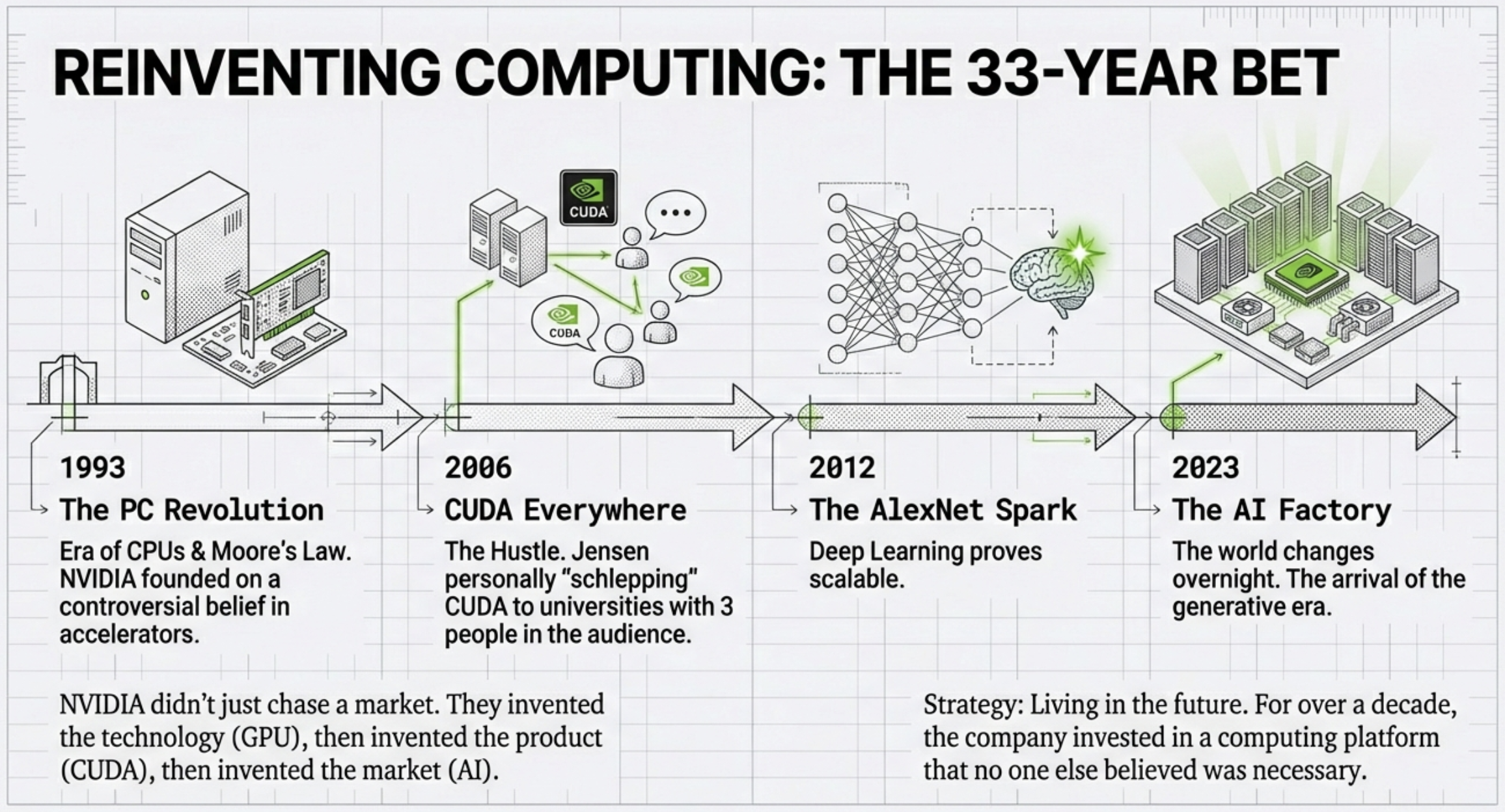
With NVIDIA’s explosive rise to the forefront of the technology world, its leather-jacket-clad CEO, Jensen Huang, has become an icon of visionary leadership. But behind the company’s staggering success lies a philosophy that runs counter to the typical Silicon Valley gospel of frictionless growth and rapid hiring. It’s a set of deeply personal and often surprising principles about leadership, character, and innovation.
In a recent, in-depth conversation, Huang pulled back the curtain on the unconventional operating system that has guided him for over three decades. This article distills five of the most impactful and counter-intuitive lessons from that discussion, revealing a mindset that views a company not just as a vehicle for shipping products, but as a crucible for forging character.
Embrace “Pain and Suffering” as a Core Value
For Jensen Huang, hardship isn’t a bug; it’s a feature. He openly calls “pain and suffering” the “secret sauce” of NVIDIA’s culture, arguing that it is essential for building corporate and individual character. Yet, what’s remarkable is how this principle is paired with its opposite: psychological safety.
Huang believes this intense process forges a unique resilience, allowing the team to endure incredible challenges and emerge stronger. This, however, is only possible because it happens within a “safe environment.” At NVIDIA, he explains, employees aren’t fired for making mistakes or “dropping passes.” The focus is on learning and enduring together. This fusion of extreme pressure and unwavering support is what allows the company to create greatness without breaking its people. As Huang puts it, “the company tortured greatness out of us… forged incredible character into us. That’s the magic of this company that you could do that not lose the person and the company not giving up on you.”
“Somehow we could… suffer pain and we can… endure incredible challenges and come out of the other side, right? And we could do it over and over and over again. And very few companies can do that as a team.”
Wield Ignorance as a Superpower
In a world that prizes foresight, Huang’s logic subverts typical Silicon Valley dogma by celebrating ignorance as a critical asset for entrepreneurs. His reasoning is brutally honest: if he had truly known how impossibly difficult it would be to build NVIDIA, he never would have even tried. If an entrepreneur could see all the setbacks, disappointments, and pain in advance, “you would never do it.”
This kind of ignorance fosters a necessary optimism, allowing leaders and their teams to tackle monumental challenges without being paralyzed by the full weight of the hardships ahead. It is the engine of ambition, enabling the first step on a journey that a fully informed person might deem irrational.
“Nvidia… would not be possible today if not for the fact that I was ignorant… In fact it’s impossible to build Nvidia… You can’t build Nvidia. You just can’t. But nobody can convince me otherwise because I didn’t know any better.”
A Company is “Neither a Church Nor a Prison”
As a young CEO in his late 20s, Huang developed a foundational philosophy that has kept his leadership grounded for decades. When asked about employee retention, he stated, “Nvidia is neither a church nor a prison. You don’t have to come and you don’t have to stay.”
The meaning is twofold: employees are not required to believe and join (“not a church”), and they are not forced to remain (“not a prison”). This isn’t a passive statement but an active philosophy driven by his own sense of personal accountability. It fosters an environment where everyone, including the CEO, must constantly earn their position. This mindset is powered by Huang’s own internal engine:
“One, I’m the best person for the job. I believe that. And two, I have to earn being the best person for that job every day.”
An Empty Chair is Better Than the Wrong Person
Huang’s hiring philosophy is defined by extreme patience. He holds the core belief that it is far better to leave a position open than to fill it with someone who isn’t the right fit for the company’s unique chemistry. This isn’t just a talking point; he famously interviewed 22 CFO candidates before finding and hiring Colette Kress.
This patience is made possible by the very culture forged through suffering: the existing team is conditioned to “swarm the mission” and cover any gaps. But the most radical part of Huang’s approach is his belief that culture is not just something you hire for, but something you create. He argues that the right person is not necessarily a perfect cultural fit on day one, but someone with the potential to be shaped by the company itself.
“I actually kind of believe that you can bring almost anybody into Nvidia and we will instill character into you,” he explains. “…we’ll forge greatness into them.”
The True Definition of “Smart” is Changing
According to Huang, the traditional definition of “smart”—raw technical intelligence and problem-solving ability—is quickly becoming a commodity that AI will easily replicate. To prove his point, he offers a powerful example: “Everybody thought software programming is the ultimate smart profession. Look what is the first thing that AI is solving? Software programming.”
In the near future, he believes the most valuable form of intelligence will be a combination of technical astuteness with deeply human traits: empathy, wisdom, and the ability to “infer the unspoken” and “see around corners.” In a world augmented by AI, it is this human-centric “vibe”—the capacity to sense what data can’t articulate—that will become the new definition of smart.
Conclusion: Building for the Long Haul
Taken together, Jensen Huang’s principles reveal a coherent and deeply integrated operating system for building a resilient, character-driven organization. The embrace of suffering forges the grit that allows a patient hiring process; that patience protects a culture capable of instilling character in its people; and the whole system is kept fresh by a leader who believes he must earn his job every single day. This is a framework designed to endure, adapt, and innovate over decades, not just quarters.
In a world chasing rapid growth at any cost, what lessons can we take from a philosophy that prioritizes suffering, patience, and ignorance on the path to success?
Sources: